Merchant Cash Advance Ireland: How It Works + Is It Right for You?

Alan Bermingham
10 Years in non banking finance
Published:
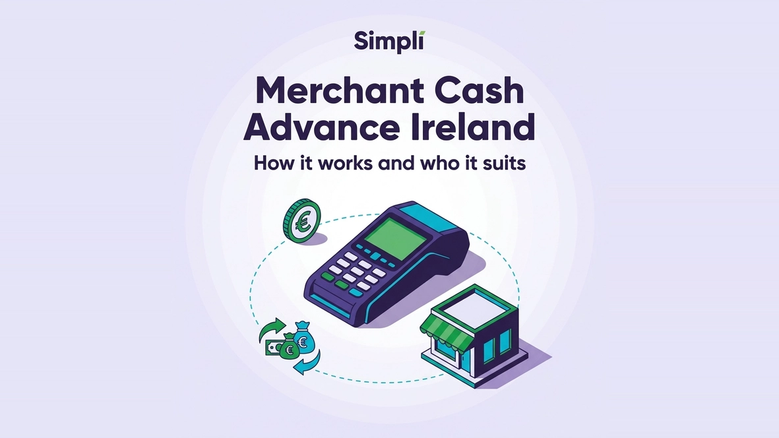
At Simpli Finance, merchant cash advances have become one of our most-requested products for hospitality, retail, and leisure businesses. The appeal is dead simple: an MCA gives you a lump sum against your future card revenue, with repayments that flex automatically with your daily sales. No fixed monthly payment, no property security, no hard CCR check. For the right business, it's one of the most accessible forms of finance in Ireland.
It's also one of the most misunderstood. The true cost of an MCA, quoted as a factor rate rather than APR, can work out a lot higher than a bank loan once you annualise it. So knowing exactly what you're signing up for is essential. Let's walk through how MCAs work, what they cost, and when they are (and aren't) the right call.
- A merchant cash advance gives a lump sum against future card revenue, repaid as a fixed % of daily card takings.
- No fixed monthly payment, no property security, and no hard CCR check.
- Pricing uses factor rates (typically 1.15-1.40), not APR. A 1.30 factor on €50,000 means €65,000 repaid.
- Best for hospitality, retail, and leisure businesses with strong card-terminal revenue.
What Is a Merchant Cash Advance
Technically, a merchant cash advance isn't a loan at all. It's the purchase of a slice of your future card revenue at a discount. The provider advances a lump sum and, in return, takes a fixed percentage of your daily card terminal receipts until the total (advance plus factor cost) is repaid. Because repayment tracks your sales rather than the calendar, there's no fixed repayment term.
MCAs are available in Ireland through our merchant services channel, as well as directly from a number of providers. Advances typically run from €5,000 to €500,000. Eligibility is mostly about card terminal revenue: most providers want to see at least €5,000 to €10,000 a month in card sales, sustained over three to six months.
How Factor Rates Work
Factor rates are how MCAs are priced. A factor rate of 1.30 means you repay €1.30 for every €1 advanced. So on a €50,000 advance at 1.30, you repay €65,000 in total: the cost of the advance is €15,000. Unlike loan interest, this doesn't shrink if you repay faster. The total repayable is locked in the moment the advance is made.
In Ireland, factor rates typically land between 1.15 and 1.40, depending on the volume and consistency of your card revenue, how long you've been trading, and your overall profile. Strong, consistent card revenue and a longer track record earn you a lower factor. Newer or more volatile businesses get offered higher ones.
How Daily Repayment Works
Repayment couldn't be more hands-off. Once the advance is funded, the provider takes a fixed percentage, usually 10% to 20%, of each day's card receipts, deducted at source by the card processor before the rest of the day's takings hit your bank account. You never make a manual payment or watch a due date.
The neat part: repayment speeds up when you're busy and slows down when you're quiet. A restaurant doing €30,000 in December repays more that month than in a €12,000 February. That automatic alignment with your revenue cycle is the defining advantage of an MCA over a fixed-term loan for seasonal businesses.
Who It Suits Best
MCAs are especially well suited to hospitality (restaurants, bars, cafés, hotels), retail shops, leisure and entertainment venues, and service businesses with serious card volumes. Basically, if a meaningful chunk of your revenue runs through card terminals, you're a candidate.
It's less suited to B2B businesses that invoice and get paid by bank transfer, to businesses with very low card volumes, or to anyone chasing longer-term finance at the lowest possible cost. For those, a term loan or a revenue-based product is usually the better shout.
- ✓No fixed monthly repayment. Moves with revenue
- ✓No hard CCR check required
- ✓No property or asset security required
- ✓Available within days. Suits urgent needs
- ✗Higher true cost than a bank term loan
- ✗Requires consistent card terminal revenue
- ✗Factor rates not directly comparable to APR
- ✗Not suitable for businesses without card payments
True Cost of an MCA
Let's be straight about the true cost. A €50,000 advance at a factor of 1.30 costs €15,000 in total. Repay it over twelve months and the effective APR is roughly 55-65%. Over six months it's considerably higher; over eighteen, lower. The factor rate itself never changes. The equivalent APR is purely a function of how long repayment takes. If you want to model the numbers, ourbusiness loan guide sets out the wider rate picture.
The real question isn't whether the cost looks high next to a bank loan. It almost always will. It's whether the capital the MCA frees up will generate more than the cost of the advance. A hospitality business that uses a €40,000 MCA to fund a kitchen upgrade that adds €10,000 a month in revenue has made a strong return, even at a high factor rate.
FAQ: Merchant Cash Advance Ireland
What is a merchant cash advance and how does it work?
A merchant cash advance is an advance against your future card terminal revenue. The provider gives you a lump sum, which you repay as a fixed percentage of your daily card sales. On busy days you repay more, on quiet days you repay less. There is no fixed term. The advance is repaid when the total amount (advance plus factor cost) has been collected from your card receipts.
Is a merchant cash advance suitable for my business?
An MCA is best suited to businesses that process significant volumes of debit and credit card transactions: hospitality, retail, leisure, and service businesses are the typical users. It is not suitable for B2B businesses that invoice customers rather than taking card payments. The minimum card revenue threshold varies by provider but is typically €5,000 to €10,000 per month.
What is a factor rate and how do I calculate the true cost?
A factor rate is a multiplier applied to the advance amount. A factor of 1.30 means you repay €1.30 for every €1 advanced: so €50,000 at a factor of 1.30 costs €65,000 in total. The cost does not change with early repayment in the way interest does. To compare it to an APR, you need to know how long the repayment takes. A 12-month repayment at factor 1.30 is broadly equivalent to 55-65% APR.
Can I get a merchant cash advance with bad credit?
Yes. MCA providers do not run hard CCR checks. They assess the application primarily on card terminal revenue history, which is pulled directly from your card processor. Businesses with imperfect CCR records regularly access MCAs because the lender's risk is secured against future card revenue, not the creditworthiness of the borrower in the traditional sense.
Is a Merchant Cash Advance Right for You?
A merchant cash advance is a genuinely powerful tool for businesses with strong card revenue that need fast, flexible capital. The repayment mechanism moves with your natural cash flow, and the lack of a hard CCR check opens it up to businesses that wouldn't get over the line at a bank. Yes, it costs more than a bank loan: but for the right business in the right moment, the value can far outweigh that cost.
At Simpli Finance, we arrange merchant cash advances through our merchant services channel and can assess your eligibility in minutes. If you process card payments and need working capital, get in touch today.
Get in touch today. The first call is free, and there's no obligation.